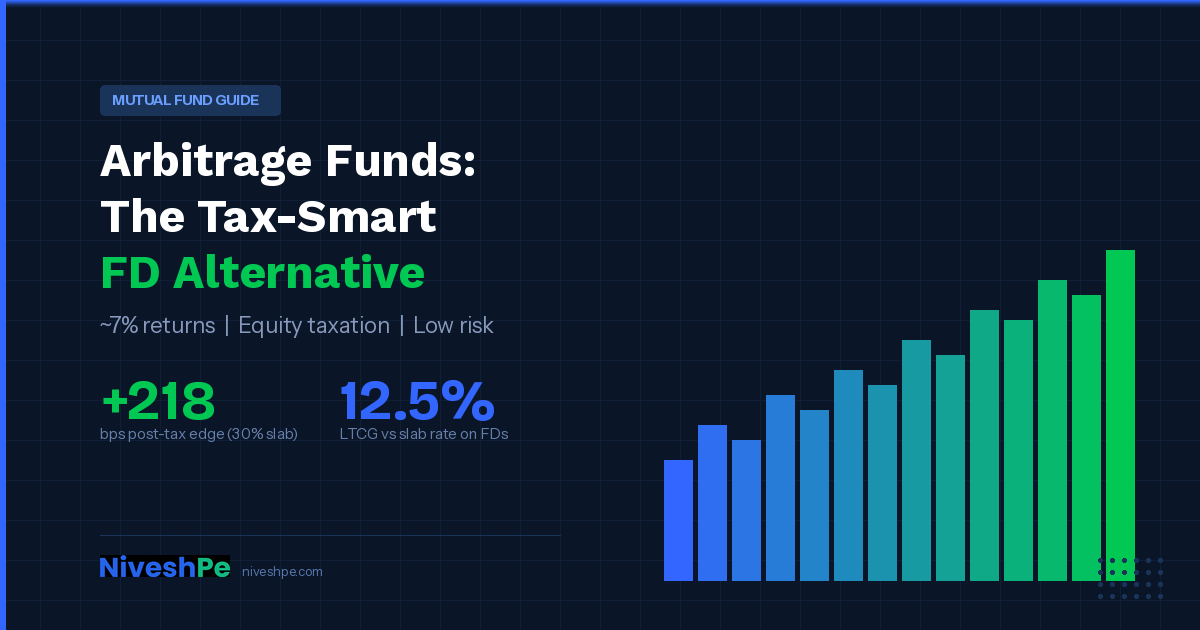
If you've already read our guide to arbitrage funds as FD alternatives, you know the core thesis: equity taxation on a debt-like product creates a structural post-tax advantage over fixed deposits for anyone in the 20% or 30% income tax slab. Arbitrage funds deliver roughly 7% with near-zero market risk, and that's a genuinely smart move for short-term parking. But here's the question nobody asks next: what if you're willing to accept a little more risk - not equity-fund-level risk, not even balanced-fund-level risk - for an extra 2-3 percentage points of annual return? That's exactly where equity savings funds sit. A category of 24 schemes managing over ₹49,194 crore in AUM, equity savings funds blend unhedged equity, arbitrage, and debt in a single wrapper - delivering 9-11% trailing 3-year CAGRs while maintaining the same equity taxation that makes arbitrage funds so attractive. For a 30%-slab investor parking ₹10 lakh for 3 years, the post-tax difference between an FD and an equity savings fund can exceed ₹1.2 lakh. This article unpacks how they work, who they're built for, the risk you're actually taking, and why a 50:50 split between equity savings and arbitrage funds may be the most intelligent FD replacement strategy available today.
What Is an Equity Savings Fund, and How Does It Differ from Arbitrage?
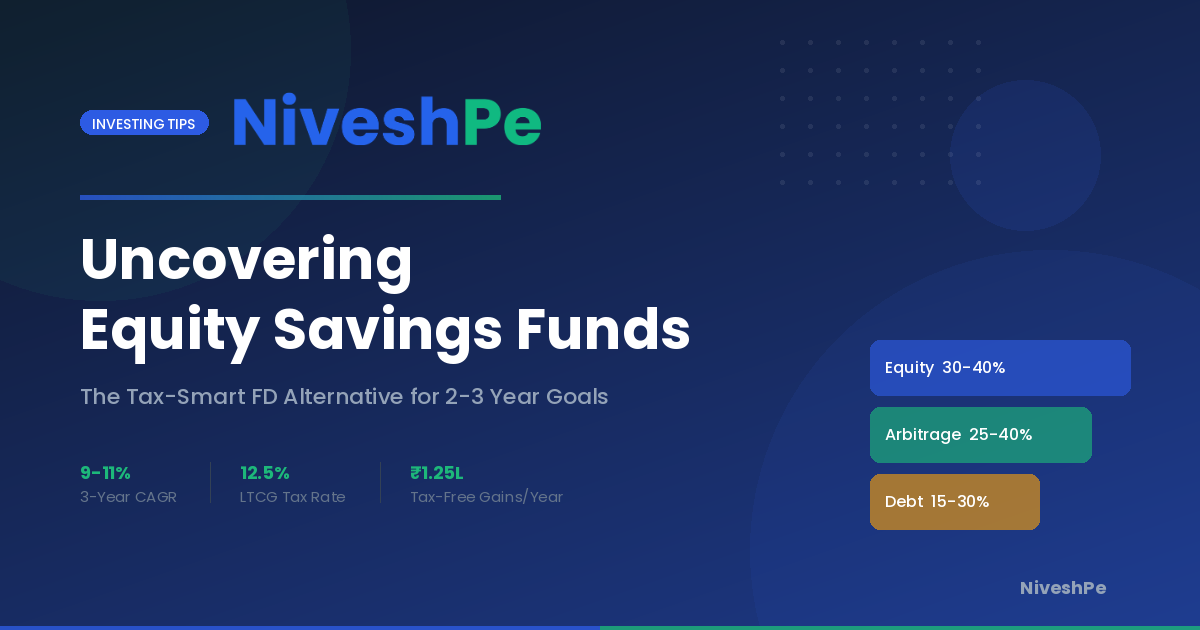
An equity savings fund is a SEBI-categorised hybrid mutual fund that invests across three distinct buckets: unhedged equity, arbitrage (hedged equity), and debt. Under SEBI's categorisation rules, the fund must maintain at least 65% of its portfolio in equity and equity-related instruments (including both unhedged stocks and hedged arbitrage positions) and a minimum of 10% in debt or money market instruments.
Here's what makes it different from a pure arbitrage fund. An arbitrage fund hedges almost all of its equity exposure - it buys stocks in the cash market and simultaneously sells futures, locking in a small spread with near-zero directional risk. An equity savings fund does the same arbitrage, but also keeps 20-40% of its portfolio in unhedged equity - actual stocks that go up and down with the market.
Typical Equity Savings Fund Portfolio Breakdown
Think of it this way: if an arbitrage fund is like a fixed deposit with better tax treatment, an equity savings fund is like a fixed deposit plus a small equity kicker. The arbitrage and debt portions (roughly 60-80% of the portfolio) provide stability. The unhedged equity portion (20-40%) adds return potential that an arbitrage fund simply cannot deliver.
Worked example: Consider a fund with ₹1,000 crore AUM. It might allocate ₹350 crore to direct stock holdings (35% unhedged equity), ₹350 crore to arbitrage positions (35% hedged equity), and ₹300 crore to debt (30%). The total "equity" on paper is 70% - comfortably above the 65% threshold for equity taxation. But the net market-exposed equity is only 35% - meaning a 10% fall in the Nifty translates to roughly a 3.5% decline in NAV, not 10%. That built-in shock absorber is the key design feature.
Why Equity Savings Funds Are Safer Than You Think
The biggest misconception about equity savings funds is that they're "equity funds" and therefore risky. They're not. They're debt-oriented hybrids that happen to qualify for equity taxation.
The standard deviation for the equity savings category is approximately 5-6%, compared to 0.83% for arbitrage funds and 12-15% for diversified equity funds. That means equity savings funds are roughly 6-7x less volatile than a typical equity fund. During the COVID crash of March 2020, when the Nifty fell over 38%, most equity savings funds declined in the range of 8-12% - painful, but a fraction of the equity market decline, and the recovery to previous NAV levels happened within 3-6 months.
Where Equity Savings Sits on the Risk Spectrum
The net effect: equity savings funds broadly resemble a portfolio of 30% equity and 70% debt - a conservative allocation by any standard. SEBI classifies most schemes in this category as "Moderate" on its risk-o-meter, sitting well below pure equity funds and even below aggressive hybrid or balanced advantage funds.
Top Equity Savings Funds in India: June 2026 Snapshot
Unlike arbitrage funds where returns are bunched within a 30-basis-point range, equity savings funds show meaningful dispersion - the difference between the best and worst 3-year CAGR is over 3 percentage points. Fund selection matters here.
| Rank | Fund (Direct Plan - Growth) | 3-Yr CAGR | AUM |
|---|---|---|---|
| 1 | Edelweiss Equity Savings Fund | 10.8% | ₹1,365 Cr |
| 2 | Kotak Equity Savings Fund | 9.8% | ₹10,100 Cr |
| 3 | Mahindra Manulife Equity Savings Fund | 8.9% | ₹526 Cr |
| 4 | DSP Equity Savings Fund | 8.5% | ₹3,478 Cr |
| 5 | Aditya Birla Sun Life Equity Savings Fund | 8.1% | ₹1,117 Cr |
Edelweiss Equity Savings Fund leads the category with a 10.8% 3-year CAGR, while Kotak Equity Savings Fund combines strong 9.8% returns with the largest AUM at over ₹10,000 crore - offering both performance and scale. The top five funds in the table all deliver meaningfully higher returns than arbitrage funds (7%) and FDs (7%), making a clear case for the equity savings category as the next step up for tax-aware conservative investors.
Taxation: The Same Equity Advantage, Applied to Higher Returns
Because equity savings funds maintain at least 65% gross exposure to equity and equity-related instruments, they receive the exact same tax treatment as arbitrage funds:
| Parameter | Equity Savings Fund | Bank FD | Debt Mutual Fund |
|---|---|---|---|
| Tax on gains < 12 months | 20% flat (Section 111A) | Slab rate (up to 31.2%) | Slab rate (up to 31.2%) |
| Tax on gains > 12 months | 12.5% (Section 112A) | Slab rate (up to 31.2%) | Slab rate (up to 31.2%) |
| Annual exemption | ₹1.25 lakh LTCG tax-free | None | None |
| When is tax paid? | Only on redemption | Annually (on accrued interest) | Only on redemption |
| Effective tax for 30% slab | 0-12.5% | 31.2% | 31.2% |
An investor earning ₹2,95,000 in gains on ₹10 lakh invested in an equity savings fund over 3 years pays just ₹21,254 in LTCG tax (after the ₹1.25 lakh exemption). The same ₹2,10,000 of cumulative FD interest over 3 years costs over ₹65,500 in tax at the 30% slab. The tax saved isn't a bonus - it's the entire thesis.
The Post-Tax Math: FD vs Equity Savings at 30% Slab
Let's get specific. ₹10 lakh invested for 3 years. Three scenarios: a bank FD at 7%, an equity savings fund at 9% (conservative category-average), and the recommended 50:50 portfolio.
Assumptions: 30% slab + 4% cess (effective 31.2%); FD at 7% with tax paid annually; Equity Savings at 9% CAGR; Arbitrage at 7% CAGR; LTCG exemption of ₹1.25 lakh fully available; gains held 3+ years.
The Recommended FD Replacement Structure
The FD Alternative: 50:50 Arbitrage and Equity Savings Split
If you're looking for a single, practical structure to replace your fixed deposits, this is it. Put half your FD corpus into an arbitrage fund and half into an equity savings fund. The arbitrage half behaves almost exactly like an FD - near-zero volatility, 7% returns, money available in T+1 - but taxed as equity instead of at your slab rate. The equity savings half adds a controlled dose of market participation (20-40% unhedged equity) that has historically delivered 9-10% over 3-year periods. Together, the blended portfolio carries roughly 15-20% effective equity exposure - conservative enough that even a 2020-style crash would dent your portfolio by only 4-6%, not 30-40%. Yet the combined post-tax return runs 2.5-3 percentage points ahead of an FD for anyone in the 20% or 30% slab. Both halves qualify for equity taxation, both benefit from the ₹1.25 lakh LTCG exemption, and both can be redeemed without penalty after 30-90 days. It's not a speculative bet on markets - it's the same conservative intent as an FD, executed through a structure that the Income Tax Act treats far more favourably.
Equity Savings vs Arbitrage: Where Does Each Fit?
Since we covered arbitrage funds in detail in our earlier article, here's the quick comparison:
| Parameter | Arbitrage Fund | Equity Savings Fund |
|---|---|---|
| Typical Return | 6.5-7.5% | 9-11% (3Y CAGR) |
| Net Equity Exposure | 0% (fully hedged) | 20-40% (unhedged) |
| Standard Deviation | ~0.83% | ~5-6% |
| SEBI Risk Rating | Low to Moderately Low | Moderate |
| Max Drawdown (COVID) | ~1-2% | ~8-12% |
| Tax Treatment | Equity (20% STCG / 12.5% LTCG) | Equity (20% STCG / 12.5% LTCG) |
| Ideal Holding Period | < 2 years | < 2 years |
| Best For | Short-term parking | Medium-term goals, FD replacement |
Who Should Invest in Equity Savings Funds
FD holders earning ₹10 lakh+ annually. If you're in the 20% or 30% slab and your FDs are generating interest taxed at slab rate, you're leaving money on the table. The tax arbitrage alone (12.5% vs 31.2%) is worth the switch, and the higher gross return is a bonus.
Conservative investors who find pure equity too volatile. If you've avoided equity mutual funds because the idea of a 20-30% drawdown makes you uncomfortable, equity savings funds are designed for you. The worst-case drawdown is structurally limited to 8-12%, and recovery happens within months, not years.
People building a corpus for 2-5 year goals. Wedding expenses, a car upgrade, a home down payment, a sabbatical fund - these are exactly the kind of goals where an equity savings fund outshines an FD without introducing unacceptable risk.
LTCG harvesting works here too. Every 13 months, redeem gains up to ₹1.25 lakh, immediately reinvest at the new NAV, and reset your cost basis. On a ₹10 lakh equity savings fund portfolio earning 9%, you'd accumulate roughly ₹93,000 in gains after 13 months - comfortably within the exemption, meaning zero tax. Repeated annually, this eliminates the LTCG bill entirely on portfolios up to ₹13-14 lakh.
Conclusion: A Smarter FD, Not a Riskier One
Equity savings funds are not about chasing returns. They're about getting more out of the same conservative intent that drives FD investing. You're allocating to a structure that is 60-80% in low-risk instruments, 20-40% in blue-chip stocks, and taxed as equity - which, in the current tax regime, is the single most important variable determining what you actually take home.
The category's ₹49,194 crore AUM across 24 schemes reflects growing investor recognition. The post-Budget 2023 world (where debt funds lost LTCG benefits) and post-Budget 2024 world (where the equity vs debt tax wedge was preserved) have together created a permanent structural advantage for any product that qualifies as "equity" while behaving like "debt-plus."
Practical takeaway: If you're in the 20% or 30% slab and have money parked in FDs for 2-3 years or longer, consider this structure: 50% in an arbitrage fund (Kotak Equity Arbitrage or Tata Arbitrage, 0.31-0.44% expense ratio) and 50% in an equity savings fund (Kotak, Edelweiss, or Mirae Asset Equity Savings, 0.40-0.68% expense ratio). Hold for at least 12 months. Harvest gains within the ₹1.25 lakh annual exemption. On ₹10 lakh over 3 years, this single shift can deliver ₹90,000-1,20,000 more in post-tax returns versus an equivalent FD - without taking on anything close to full equity risk.
Start building your tax-smart portfolio today - explore equity savings and arbitrage funds on NiveshPe and let your money work the way it should.
Disclaimer: Past performance does not guarantee future returns. Mutual fund investments are subject to market risks - read all scheme-related documents carefully. Tax rules are subject to change. Consult a financial advisor before investing.