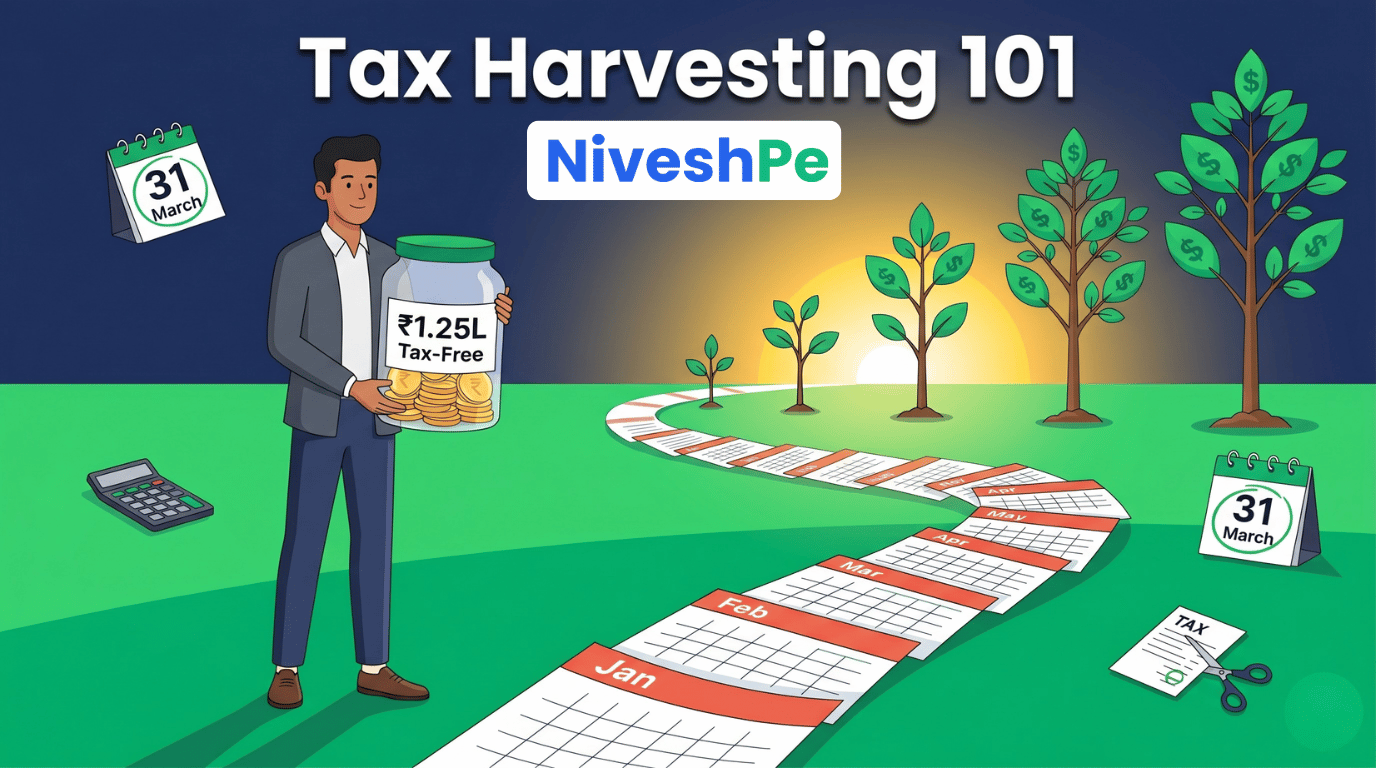
Tax Harvesting 101:
How to Make ₹1.25 Lakh of MF Gains Tax-Free Every Year
Most investors don't know this exemption exists. The ones who do save ₹15,000+ a year without changing a single fund. Here's the complete playbook.
Tax-gain harvesting lets Indian investors book up to ₹1.25 lakh in long-term capital gains from equity mutual funds completely tax-free every financial year. By selling and reinvesting before 31 March, you reset your cost base higher, saving up to ₹15,625 in tax annually — without changing a single fund in your portfolio.
What if you could make ₹1.25 lakh of your mutual fund profits completely tax-free, every single year?
It's called tax-gain harvesting. The idea is simple: every year before 31 March, you sell just enough equity mutual fund units to book up to ₹1.25 lakh in long-term gains (which is tax-exempt), then reinvest the money. Your cost base resets higher, your future tax bill shrinks, and you haven't changed your investment at all.
Max annual saving: ₹15,625. Over 10 years, that's ₹1.5 lakh+ kept in your pocket. But most investors don't do this because they don't understand the rules that make it necessary. Let's fix that.
Mutual funds are no longer niche. They're mainstream habit for crores of Indians. And most of these investors have never thought about tax on their gains.
as of May 2026
May 2026
accounts
(up from 15%)
Most of these investors started SIPs in the last 3-4 years. They've never redeemed. They've never dealt with capital gains tax. And many don't know that the rules changed on 23 July 2024, making it more expensive to get the timing wrong.
Meet Narendra
To make all of this concrete, let's follow one investor through three different outcomes.
Narendra Kulkarni
35 years old. Senior software engineer in Bengaluru. Married, one kid starting school soon. Started investing seriously in 2025.
Narendra started a ₹15,000/month SIP in a flexi-cap equity fund in January 2025. But before we look at his scenarios, we need to understand the two rules that will decide how much tax he pays: the new tax rates and the FIFO trap.
The New Tax Rates (Since July 2024)
Budget 2024 changed the game. Budget 2026 left these rates untouched, so this is what applies right now and into FY 2026-27.
| Type | Holding | Tax Rate | Exemption | What changed |
|---|---|---|---|---|
| LTCG Sec 112A | > 12 months | 12.5% | First ₹1.25L/year tax-free | Was 10% over ₹1L |
| STCG Sec 111A | ≤ 12 months | 20% | None. Every rupee taxable | Was 15% — a 33% hike |
💡 The subtle math
Despite the higher LTCG rate, moderate gains can actually be taxed less than before. Old: 10% on ₹1L above ₹1L exemption = ₹10,000. New: 12.5% on ₹75K above ₹1.25L exemption = ₹9,375. The real pain is in STCG: ₹1L of short-term gain now costs ₹20,000 vs ₹15,000 before. That's where investors get hurt.
The FIFO Trap: Why Your SIP Is Not One Investment
This is the part that catches almost every SIP investor off guard. The tax department doesn't see your SIP as one investment. Each monthly instalment is a separate purchase, with its own purchase date and its own 12-month holding clock. When you redeem, units are sold in FIFO order (First In, First Out) — oldest units go first.
Here's what Narendra's 18-month SIP actually looks like to the tax department if he redeems everything in June 2026:
FIFO = Oldest units are sold first. A single redemption triggers both LTCG and STCG depending on when each instalment was purchased.
Two-thirds of Narendra's SIP gets taxed at the higher rate. Not because he picked the wrong fund, but because he redeemed before those instalments turned one year old. The FIFO structure means the cheaper, older units get sold first (good), but the bulk of recent units that follow get hammered by 20% STCG and exit load (bad).
Three Scenarios, Three Very Different Outcomes
Same person, same fund, same SIP. The only difference is when and how Narendra redeems.
June 2026. Narendra needs money urgently. He redeems everything in one shot.
| Detail | Amount |
|---|---|
| Total invested (18 × ₹15,000) | ₹2,70,000 |
| Portfolio value (~12% annual return) | ₹2,98,000 |
| Total gain | ₹28,000 |
| LTCG (first 6 instalments) | ₹9,000 12.5% |
| STCG (last 12 instalments) | ₹19,000 20% |
Total damage: ~₹5,600 + cess. That's 20% of his ₹28,000 gain, gone. And the ₹1.25L LTCG exemption? Barely scratched. Only ₹9,000 out of ₹1,25,000 was used.
Narendra waits until June 2027. Now every instalment has crossed 12 months. Same fund, same SIP. Just patience.
| Detail | Amount |
|---|---|
| Total invested (same ₹2,70,000) | ₹2,70,000 |
| Portfolio value (~12% annual, 30 months) | ~₹3,42,000 |
| Total gain — 100% LTCG | ~₹72,000 LTCG |
Total tax: ₹0. Total exit load: ₹0. A bigger gain than Scenario 1, and he keeps every paisa. The only cost was time.
Now let's scale it up. Narendra stays invested for 7 years and builds a serious corpus.
| Detail | Amount |
|---|---|
| Total invested (7 yr × 12 × ₹15,000) | ₹12,60,000 |
| Portfolio value (~12% annual) | ~₹19,60,000 |
| Total long-term gain | ~₹7,00,000 |
Two ways this plays out:
❌ Redeems everything in Year 7
No harvesting done over the years
✅ Harvested ₹1.25L each year
Booked tax-free gains every March
The Tax-Gain Harvesting Playbook
You saw the idea at the top. Here's exactly how to execute it. The ₹1.25 lakh LTCG exemption is per financial year and does not carry forward. Any year you don't use it, it's gone forever.
Check Your Gains
Download your Consolidated Account Statement from CAMS or KFintech. Identify equity fund units held over 12 months sitting on unrealised gains.
Sell Up to ₹1.25L
Redeem just enough units so realised LTCG for the year stays at or under ₹1.25 lakh. This portion is completely tax-free.
Reinvest Immediately
Put the proceeds back into the same fund (or a similar one). This resets your cost base higher, so future gains are smaller.
Repeat Before 31 March
Do this every year before the financial year ends. The exemption resets to zero on 1 April. Make it an annual habit.
🎯 Maximum annual tax saved
12.5% × ₹1,25,000 = ₹15,625 per year. Over 10 years, that's ₹1.5 lakh+ kept in your pocket. Compound that reinvested saving and the difference grows even more.
Watch-outs
| Risk | What to do |
|---|---|
| Exit load — Units under 12 months carry ~1% load | Only harvest units past the 12-month mark |
| NAV gap risk — Market can move between sell and buy | Reinvest on the same day or next business day |
| Holding period resets — New units start a fresh 12-month clock | Don't harvest money you may need within a year |
| Aggregate limit — ₹1.25L is across all equity shares + funds | Track total exemption usage from stocks and all funds together |
Bonus: Use Losses to Cut Tax Even Further
If some of your investments are in the red, those losses are a tax asset. Here's how set-off works:
| Loss Type | Can Offset | Cannot Offset | Carry Forward |
|---|---|---|---|
| Short-term loss (STCL) | STCG + LTCG | Salary, rent, other income | 8 years |
| Long-term loss (LTCL) | LTCG only | STCG, salary, other income | 8 years |
⚡ Pro tip: Set off STCL against STCG first
STCG is taxed at 20%, LTCG at 12.5%. Offsetting losses against the higher-taxed gains saves more per rupee. And critically: you must file your ITR by the due date to preserve carry-forward rights. Miss the deadline and the carry-forward is lost permanently.
Narendra's Annual Tax Calendar
Here's how Narendra now organises his investing year:
Five Mistakes Costing You Real Money
Narendra's Scorecard
| Scenario | Total Gain | Tax Paid | Effective Rate | Verdict |
|---|---|---|---|---|
| ❌ Panic exit (18 months) | ₹28,000 | ~₹5,600 | ~20% | Avoidable |
| ✅ Patient exit (30 months) | ₹72,000 | ₹0 | 0% | Smart |
| ❌ 7-year lump-sum exit | ₹7,00,000 | ~₹74,750 | ~10.7% | Could be better |
| 🧠 7 years + harvesting | ₹7,00,000 | ~₹9,750 | ~1.4% | Optimal |
The Bottom Line
The Indian tax code rewards patience and punishes impulsiveness. The difference between a 20% effective rate and near-zero isn't a fancy product or an expensive CA. It's three habits:
Wait
Let every SIP instalment cross 12 months before redeeming
Harvest
Book ₹1.25L of LTCG tax-free every March
File
File ITR on time to preserve loss carry-forward
No loopholes. No grey areas. Just using the exemptions the government already gave you.
The real challenge, of course, isn't knowing this. It's doing it consistently. Tracking holding periods across multiple SIPs, calculating how much exemption you've used, figuring out which lots to sell and when to reinvest. Every January, Narendra used to open a spreadsheet, squint at his CAS, and hope he got the math right.
That's actually why we built automatic tax harvesting into the NiveshPe platform. Before every financial year-end, the system scans your portfolio, identifies units that qualify for tax-free harvesting, calculates exactly how much of your ₹1.25 lakh exemption is still unused, and executes the harvest with a single tap. No spreadsheets, no guesswork, no missed years. And if your situation is more complex (multiple funds, loss set-offs, a large redemption you're planning), your dedicated NiveshPe advisor can walk you through a personalised harvesting plan over a call. Think of it as the difference between knowing you should go to the gym and having a trainer who texts you every morning.
Frequently Asked Questions
What is tax-gain harvesting in mutual funds?
Tax-gain harvesting is a strategy where you sell equity mutual fund units each year to book up to ₹1.25 lakh in long-term capital gains (LTCG) tax-free, then immediately reinvest the money. This resets your cost base higher, reducing future tax liability without changing your investment.
How much LTCG is tax-free on mutual funds in India?
Long-term capital gains up to ₹1.25 lakh per financial year from equity mutual funds and shares are completely tax-free. Gains above ₹1.25 lakh are taxed at 12.5%. This exemption resets every April 1 and does not carry forward.
What is the FIFO rule in mutual fund taxation?
FIFO (First In, First Out) means when you redeem mutual fund units, the oldest units are sold first. For SIP investors, this matters because early instalments (held over 12 months) qualify as LTCG at 12.5%, while recent instalments (under 12 months) attract STCG at 20%.
What are the current LTCG and STCG tax rates on equity mutual funds?
As of July 2024: LTCG (units held over 12 months) is taxed at 12.5% on gains above ₹1.25 lakh. STCG (units held under 12 months) is taxed at 20%. The ₹1.25 lakh LTCG exemption is per financial year across all equity investments.
How much tax can I save with tax-gain harvesting every year?
By harvesting ₹1.25 lakh in LTCG annually, you save 12.5% × ₹1,25,000 = ₹15,625 per year. Over 10 years, that's ₹1.5 lakh+ in tax savings. When reinvested, the compounded savings grow even larger.