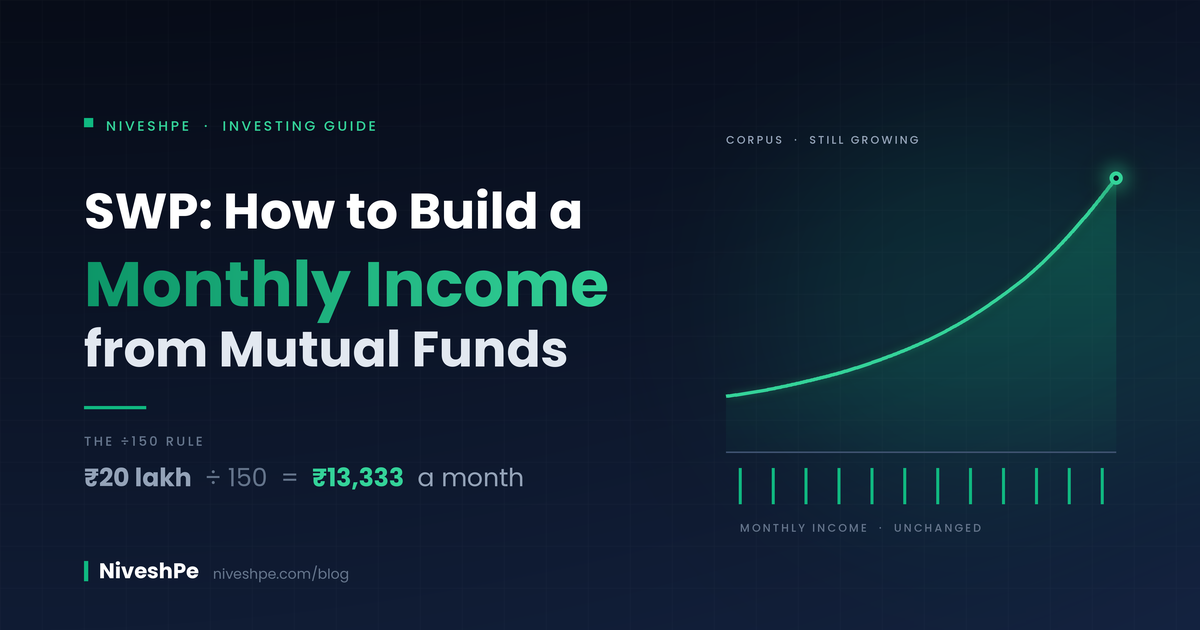
Every FD renewal letter this year carries the same bad news: big-bank one-year rates sit near 6.25% and keep drifting lower after the RBI's 2025 cutting cycle took the repo to 5.25%. For anyone who needs monthly income - a retiree, a family running on one salary, a professional planning a break - the old income machine now pays less for the same money, and every rupee of it is taxed at slab. There is a better machine. A Systematic Withdrawal Plan (SWP) turns a mutual fund lumpsum into a monthly salary: under the ÷150 rule, ₹20 lakh pays ₹13,333 a month, and in our 12% illustration the corpus still grows to roughly ₹71 lakh over 20 years - after paying out ₹32 lakh. The same ₹20 lakh in an FD? About ₹7,300 a month in hand at the 30% slab, with the corpus frozen forever. This guide is the full playbook: the withdrawal rate that is actually sustainable, the four-fund portfolio built for it, the tax math nobody shows you, and the mistakes that kill SWPs.
What an SWP Actually Is
An SWP is an SIP running in reverse. With an SIP, a fixed amount leaves your bank account every month and buys mutual fund units. With an SWP, the fund house automatically redeems a fixed amount of units every month and credits it to your bank account - same date, same amount, like a salary. Everything that has not been withdrawn stays invested and keeps compounding.
Three properties make it different from every other income product.
Four steps, then it runs itself
The withdrawal is a redemption of units, not "interest". That single difference drives both the income advantage and the tax advantage this article quantifies.
One picture to keep: an SIP fills the bucket. An SWP fits a tap to it - sized so the bucket refills faster than the tap drains it. Get the tap size right, and the bucket never empties. Get greedy with the tap, and no bucket survives. The rest of this article is about sizing the tap.
The Engine: Earn 12-14%, Withdraw 8-10%
Every sustainable SWP rests on one inequality: the portfolio must earn more than you withdraw. That is the entire theory. Our thesis at NiveshPe puts numbers on it: a withdrawal of 8-10% of the corpus a year is sustainable when the portfolio behind it is engineered to earn more - and NiveshPe's SWP portfolios are designed to target 12-14% over full market cycles. The gap between the two, a 2-4% buffer, is not leftover money. It is the engine oil: it stays invested, absorbs the bad years, and quietly grows the corpus so your income can grow with it.
Where every percentage point of return goes
Targets are design goals grounded in long-term category history, not assured returns. Precisely because returns arrive unevenly, the withdrawal is set at 8-10%, not at the target itself.
Notice what this framing does to the FD comparison. An FD pays you its entire return - and freezes the principal in nominal terms forever, which means inflation eats it alive. An SWP deliberately pays you less than the portfolio earns, and that restraint is exactly what makes the income durable and growable. The FD maximises today's payout. The SWP maximises the number of years the payout survives - and grows.
The ÷150 Rule: Your Lumpsum's Monthly Salary
You do not need a spreadsheet to size the tap. Use the rule of thumb we use inside NiveshPe: divide the lumpsum by 150. That is the monthly income it can pay. The arithmetic behind it is simple - ₹150 of corpus paying ₹1 a month is ₹12 a year, which is an 8% annual withdrawal: the conservative end of the sustainable 8-10% band. Starting at the safe end is deliberate. An income you can raise later beats an income you are forced to cut.
One division, and you know your number
Rows show the starting income under the ÷150 rule. The green row is the minimum corpus at which we recommend switching an SWP on; below it, build with SIPs first.
Run your own numbers: the NiveshPe SWP Calculator lets you test any lumpsum, withdrawal amount and return assumption, and watch the corpus path month by month - the same math this article uses.
The Three Fates of ₹20 Lakh
Here is the entire discipline of SWP in one chart. The same ₹20 lakh, paying a monthly income for 20 years, under three settings. The green line follows the rule - ₹13,333 a month (8%) with the portfolio compounding at 12% - and ends at roughly ₹71 lakh after paying out ₹32 lakh along the way. The blue line is the same withdrawal in a stingier world of 10% returns: the corpus still grows to about ₹39 lakh. The red line is what greed does: ₹20,000 a month (a 12% withdrawal) at those same 10% returns - the corpus bleeds slowly for a decade, then collapses, and is gone in about 17 years.
Withdraw 8% and the corpus grows. Withdraw 12% and it dies.
Illustration with ₹13,333 or ₹20,000 withdrawn monthly and returns compounding at a constant assumed rate; actual returns vary year to year and outcomes will differ. Not a projection or a guarantee.
Read the red line carefully, because it is the most common SWP failure in the wild. Nothing dramatic happens in year one - the corpus dips gently, the income arrives on time, everything feels fine. The damage is invisible for a decade. By the time the slope steepens, the corpus is too small for any return to rescue it. The difference between the green line and the red line is not the market. It is four percentage points of withdrawal discipline, chosen on day one.
SWP vs FD vs Annuity: What Actually Lands in Your Account
Now the comparison every income-seeker actually cares about: on the same ₹20 lakh, what hits the bank every month after tax? An FD at 6.25% pays ₹10,417 - before tax. Interest is taxed at your slab, so at 30% roughly ₹7,300 lands in hand. An immediate annuity (with return of purchase price) pays a similar ₹10,000-10,800 at typical current rates, also fully taxed at slab - call it ₹7,000-7,600 in hand, with your capital locked away for life. The SWP pays ₹13,333, and as the next section shows, early-year tax on it is measured in hundreds, not thousands.
Same money, three machines: what you keep each month
FD and annuity payouts are fully taxable as income; figures assume the 30% slab (cess would trim them further) and indicative mid-2026 rates. SWP withdrawals are taxed only on the gain slice - see the next section. Lower slabs narrow the gap but do not close it.
The qualities that decide the next 20 years
The honest caveat: an SWP carries market risk that FDs and annuities do not. The portfolio design in section 7 exists precisely to manage that risk - it does not eliminate it.
The Tax Math Nobody Shows You
This is where SWP quietly wins by the largest margin, and almost no one explains why. FD interest is income - every rupee of it is taxed at your slab, every year, via TDS. An SWP withdrawal is a redemption - and a redemption has two slices: your own principal coming back to you, which is never taxed, and the gain on the units sold, which is. In the early years of an SWP, the gain slice of each withdrawal is tiny, because most of what you are withdrawing is simply your own money.
On the gains themselves, the equity-taxed sleeves of the portfolio (equity savings, arbitrage, multicap) enjoy the friendliest rates in the tax code: gains on units held over 12 months are LTCG at 12.5%, and only beyond the ₹1.25 lakh annual exemption; units sold within 12 months attract STCG at 20%. Gains from the conservative hybrid sleeve are taxed at your slab. Two practical upgrades follow. First, season the corpus: where possible, invest the lumpsum about 12 months before the first withdrawal, so redemptions qualify as long-term from day one. Second, use the exemption every year - the same ₹1.25 lakh LTCG allowance our tax harvesting guide shows you how to farm.
The same income, two tax bills
Nearly a quarter of the income, gone - every single year.
Most of what you withdrew was your own capital.
Illustration: portfolio drifting up ~12% over year one, so the gain slice averages a few percent of each withdrawal, taxed at 20% STCG in year one (falling to 12.5% LTCG with the ₹1.25L exemption thereafter). Exact figures depend on returns, sleeves redeemed and holding period. Both machines' tax bills grow over time - the FD's stays permanently at slab; the SWP's gains slice grows slowly and stays capped at 12.5% beyond the exemption.
The NiveshPe SWP Portfolio: Four Sleeves, One Job
An SWP should never run on a single fund, and never on pure equity. The reason has a name - sequence-of-returns risk. A crash in year 12 of an SWP is a bad month. The same crash in year 1 is a wound that never heals, because every withdrawal made at depressed prices sells extra units that can never compound back. The fix is structural: build the portfolio so that a bad year's withdrawals never have to come from equity sold at the bottom. This is the four-sleeve mix NiveshPe uses.
50 / 20 / 15 / 15: every sleeve has one job
Category-level construction, not scheme recommendations; the ~10% figure is the equity savings category's long-run character, not a promise. Together the sleeves are engineered toward the 12-14% cycle target with drawdowns the 2-4% buffer can absorb.
How the sleeves work in a crash: when equity has a 2020-style year, that month's withdrawals are sourced from the arbitrage and hybrid sleeves - which barely flinch - while the equity sleeves are left alone to recover. When markets are strong, withdrawals come from the winners, quietly rebalancing the portfolio. The income never changes; only the sleeve paying it does. That sequencing is the difference between an SWP that survives crashes and one that is destroyed by the first one.
Five Mistakes That Kill an SWP
SWPs rarely fail because markets misbehave. They fail because of five setup and maintenance errors - all avoidable, all common. If the chart in section 4 showed you what discipline earns, this is the checklist that protects it.
Five ways SWPs die - and the rule that prevents each
The Verdict: Size the Tap, Build the Engine, Review Once a Year
An FD pays you interest and keeps your money idle. An annuity pays you certainty and keeps your money, full stop. An SWP pays you more, taxes you less, and keeps your money working - provided you size the tap with ÷150, build the four-sleeve engine behind it, and review it once a year.
Four rules, and the income outlives you
Miss any one of these and you are on the red line without knowing it. Run all four and a ₹20 lakh corpus becomes a salary that never resigns.
That is the whole thesis, and it is worth restating in one breath. Withdrawals of 8-10% a year are sustainable when the portfolio is designed to earn 12-14% across cycles, because the 2-4% buffer stays invested and compounds. The ÷150 rule pins you to the safe end of that band. The 50/20/15/15 structure makes sure a crash never forces you to sell equity to fund a payout. The annual review turns a growing corpus into a growing income. Miss any one of these and you are on the red line without knowing it. Run all four and a ₹20 lakh corpus becomes what it should have been all along: a salary that never resigns.
Practical takeaway: Start at ₹20 lakh or more. Divide by 150 for the monthly amount - and never breach 10%. Run it on the four-sleeve mix: equity savings core (50%), conservative hybrid stability (20%), multicap growth (15%), arbitrage shock absorber (15%). Choose Growth options, never IDCW. Season the corpus 12 months where you can. Review yearly: step up ~5% when the corpus runs ahead of plan. That is the whole machine.
This is exactly the machine NiveshPe builds. Tell ORBIT the income you need, and it sizes the corpus, constructs the four-sleeve portfolio, sequences every withdrawal from the most tax-efficient sleeve, watches the buffer through every market cycle, and tells you when the corpus has earned you a raise. HNI-grade income planning, from a ₹20 lakh start.
Disclaimer: Mutual fund investments are subject to market risks. Read all scheme related documents carefully. All corpus and income figures in this article are illustrations at assumed rates of return (10-14%) for education; they are not projections, forecasts or assured returns, and actual outcomes will vary with markets. Portfolio return targets are design goals, not guarantees. Category descriptions (equity savings, conservative hybrid, multicap, arbitrage) are educational and not recommendations of any scheme. Tax treatment is as per prevailing law for FY 2026-27 and may change; FD, annuity and policy-rate figures are indicative as of August 2026. NiveshPe is a product of Futurewell Fintech Private Limited, an AMFI-registered Mutual Fund Distributor (ARN-344035) distributing regular plans. This article is educational and not investment, tax or insurance advice; consult a registered adviser before investing.