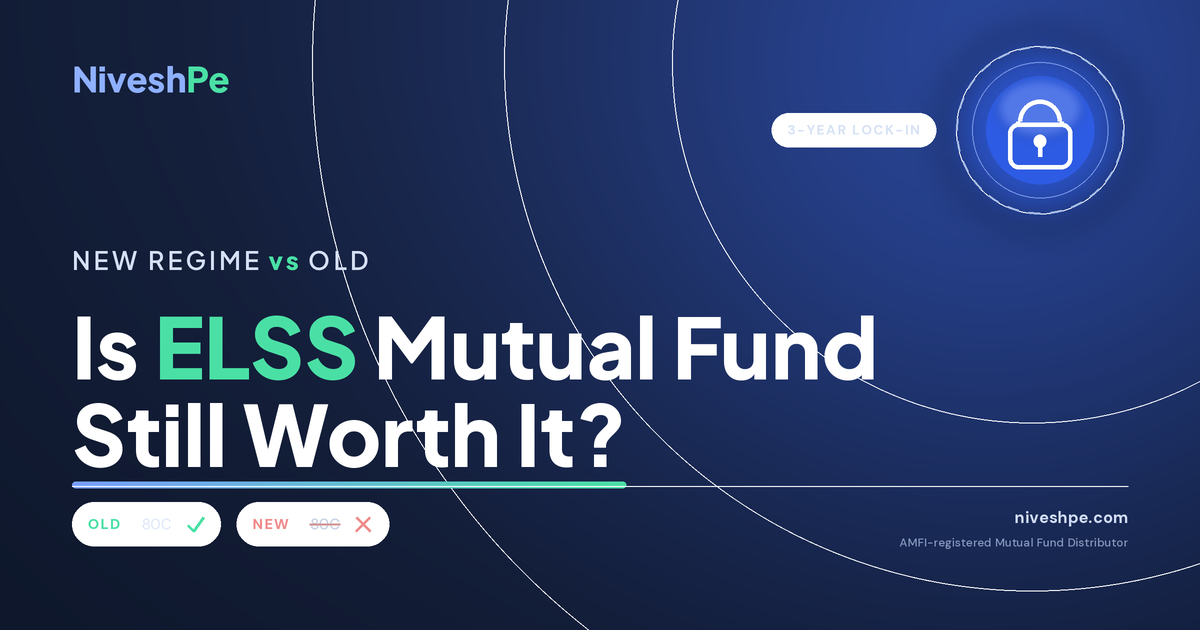
Why this question suddenly matters
ELSS - an Equity Linked Savings Scheme - was built for a very specific job: give you exposure to equity and a tax deduction under Section 80C, in one product. For a taxpayer on the old regime, that combination was genuinely useful. You were going to invest in equity anyway, so you might as well save tax on the same rupee.
Then the ground shifted. The new tax regime is now the default, and it does not allow Section 80C at all. And investors have voted with their feet.
Here is what that means in practice. If you have moved to the new regime - as most people have - the deduction that made ELSS special no longer applies to you. But the product's defining feature, the three-year lock-in, does not go away. You are still handing over your liquidity. You are just no longer getting a tax break in exchange.
On the new regime, an ELSS fund is a diversified equity fund with a three-year lock-in and a tax benefit you can no longer use. The lock stays. The reason for it is gone.
First, where do you actually stand?
This whole decision hinges on one thing: which regime you are on. So let us get the FY2025-26 picture straight before we talk funds.
Under the new regime (the default), the slabs were widened in Budget 2025 and a higher rebate under Section 87A means tax is effectively nil on taxable income up to ₹12 lakh. For salaried individuals, the ₹75,000 standard deduction pushes that break-even to about ₹12.75 lakh. In exchange for the lower rates, you give up almost every deduction - including 80C, 80D, HRA and home-loan interest under Section 24(b). (One notable survivor: the employer's NPS contribution under Section 80CCD(2).) Note that the rebate does not apply to capital gains.
Under the old regime (now something you must actively opt into), the slabs are higher, but you keep the full toolkit: 80C up to ₹1.5 lakh, 80D for health insurance, HRA, and home-loan interest up to ₹2 lakh. This is the only regime where ELSS earns a tax deduction at all.
| New regime (default) | Old regime (opt-in) | |
|---|---|---|
| Zero-tax income (salaried) | Up to ~₹12.75 lakh | Up to ₹5 lakh |
| Section 80C (incl. ELSS) | Not available | Up to ₹1.5 lakh |
| 80D, HRA, home-loan interest | Not available | Available |
| Standard deduction (salaried) | ₹75,000 | ₹50,000 |
| Does ELSS save you tax? | No | Yes |
Switching regimes: because the new regime is the default, salaried taxpayers without business income can simply choose the old regime each year while filing their return - no separate form. If you have business or professional income, you must file Form 10-IEA to opt out, and you get only one round trip (new → old → new); once you return to the new regime you cannot go back to old unless the business income ceases.
What you're really buyingWhat an ELSS fund actually is
Strip away the tax label and an ELSS fund is a diversified equity mutual fund that can invest across large, mid and small caps. In other words, it is structurally almost identical to a flexi-cap fund - with two differences bolted on: a three-year lock-in, and 80C eligibility (which, again, only counts on the old regime).
This matters because of a common myth: that ELSS is somehow a higher-return category. It is not a separate asset class. Its returns come from the same equity markets as every other diversified equity fund.
Over the long run, ELSS category returns have been broadly in line with diversified equity funds such as flexi-cap funds - for instance, both delivered around 14% annualised over the three years to early 2023, per data reported by Business Standard and Value Research. Past performance may or may not be sustained in future.
So the honest framing is not "ELSS gives you less" or "other funds give you more." It is that ELSS gives you roughly the same growth potential as its open-ended equity cousins - but asks you to lock it up for three years. On the old regime, the tax deduction was your compensation for that lock-in. On the new regime, there is no compensation left.
The liquidity mathThe shortest lock-in among tax-savers - but still a lock-in
To be fair to ELSS, among the 80C tax-saving options it is by far the most liquid. Three years looks generous next to a five-year tax-saving FD or a fifteen-year PPF.
Among 80C instruments, ELSS has the shortest lock-in. But the real benchmark for equity money on the new regime is an open-ended fund - where the lock-in is zero.
Notice the row at the very top. Once the tax deduction is off the table, the correct thing to compare ELSS against is not PPF or an FD - it is an open-ended equity fund with the same growth potential and no lock-in at all. Against that benchmark, three years stops looking short.
The core ideaThe trade that no longer trades
Every ELSS investment is a trade: you give up liquidity for three years, and you get a tax deduction in return. Whether that trade is worth it comes down to one question - do you actually receive the deduction?
You get the 80C deduction on up to ₹1.5 lakh, and ELSS gives you that with the shortest lock-in and the growth potential of equity. If you have unused 80C headroom, ELSS remains a sensible way to fill it.
There is no deduction to receive - so you are locking your money for three years and getting nothing back for it. An open-ended equity fund offers the same category growth potential, and you stay free to rebalance, redeploy or exit whenever your plan needs it.
And before anyone reaches for the "but ELSS is more tax-efficient at redemption" argument - it is not. Since the 2024 Budget, all equity mutual funds are taxed identically: long-term capital gains at 12.5% above the ₹1.25 lakh annual exemption. ELSS's lock-in simply means its gains are always long-term. There is no exit-tax advantage over a flexi-cap fund either.
For a new-regime investor, the case for ELSS rests entirely on a benefit they no longer receive. Same growth potential, but with a three-year lock-in and no tax break - that is a worse deal than an open-ended equity fund, not a better one.
The honest counterpoint
This is not a hit piece on ELSS, and there are two situations where it still earns its place.
One: the lock-in as a discipline tool. There is a behavioural argument - made by Value Research among others - that being unable to touch your money for three years stops you from panic-selling during a market dip, and can build good habits, especially for first-time investors. That is a real, if double-edged, benefit: the same lock also stops you from exiting a fund that is losing form.
Two: old-regime investors with 80C headroom. If, after adding up home-loan interest, HRA and other deductions, the old regime genuinely works out better for you, then ELSS is one of the best equity ways to use your ₹1.5 lakh 80C limit.
Worth watching: for Budget 2026, AMFI has proposed a fresh ELSS incentive under the new regime. As of now this is only an industry proposal, not law - so it does not change the picture today, but it is a space to keep an eye on.
So - is ELSS and 80C still worth it?
It comes down to a single fork. Answer one question and the decision usually makes itself.
The 80C deduction does not apply to you, so there is little reason to accept a three-year lock-in. An open-ended equity fund gives you the same category growth potential while keeping your money flexible.
It is the shortest-lock-in, equity-style way to use your ₹1.5 lakh 80C limit - a genuinely reasonable choice for that specific job.
Put simply: 80C is not "dead" - but for the majority now on the new regime, it is switched off, and with it, the main reason ELSS existed. If you are in that majority, the smarter default for your equity money is an open-ended fund that never locks you out of your own plan.
Here is what that flexibility actually gives you:
Redeem or redeploy any day
Rebalance when your plan changes
Switch out a fund losing form
Same equity growth potential
Don't guess whether your equity money is in the right place
The hard part is not the theory - it is knowing whether your funds are pulling their weight, and what to do about it. That is exactly what NiveshPe's Orbit engine is built for.
- Sync your existing mutual funds and see, in one view, which are in form and which are drifting
- Get a portfolio built around your goals and horizon - with clear, tap-to-approve suggestions
- Start or adjust an SIP into open-ended funds that keep your money working and flexible
- A registered professional is always a tap away when a decision needs human judgement
Disclaimer: This article is for general educational purposes only and is not investment, tax or legal advice. Tax rules referenced are for FY2025-26 (AY2026-27) and may change; please verify your own position or consult a qualified tax professional. Mutual fund investments are subject to market risks - read all scheme related documents carefully. Past performance may or may not be sustained in future and does not guarantee future results. NiveshPe is a product of Futurewell Fintech Private Limited, an AMFI-registered Mutual Fund Distributor (ARN: 344035); we distribute regular plans of mutual funds.
Frequently Asked Questions
Does ELSS still give a tax benefit under the new tax regime?
No. Section 80C is not available under the new tax regime, so money you put into an ELSS fund while on the new regime does not earn a deduction. The deduction of up to ₹1.5 lakh applies only if you have opted for the old tax regime.
Is ELSS a bad investment now?
Not bad - it is a diversified equity fund whose long-run returns have historically been broadly comparable to categories such as flexi-cap funds. The real question is whether its three-year lock-in still buys you anything. Under the new regime it does not, so an open-ended equity fund may suit you better because it keeps your money liquid. If you are on the old regime and using your 80C limit, ELSS remains a strong choice.
Are ELSS and other equity funds taxed differently when I sell?
No. Since the 2024 Budget, equity mutual funds including ELSS are taxed alike - long-term capital gains at 12.5% above the ₹1.25 lakh annual exemption. Because ELSS is locked for three years, its gains are always long-term. So there is no tax advantage at redemption versus an open-ended equity fund.
For tax saving under the old regime, is ELSS better than PPF or a tax-saving FD?
They serve different needs. Among 80C options, ELSS has the shortest lock-in - three years, versus five for NSC, tax-saving FDs and ULIPs, and fifteen for PPF - and offers the growth potential of equity along with the risk of equity. PPF and tax-saving FDs offer fixed, stable, lower returns. The right pick depends on your risk appetite and time horizon.
I have business income - can I switch to the old regime to claim ELSS?
The new regime is the default. Salaried individuals without business income can choose the old regime afresh each year while filing their return. Those with business or professional income must file Form 10-IEA to opt out, and can switch only once - new to old and back to new - after which they cannot return to the old regime unless the business income ceases.
Should I stop my existing ELSS SIP?
Each ELSS SIP installment stays locked for three years from its own purchase date, and you can pause or stop future installments at any time. Whether to continue depends on which regime you are on and your goals. Consider your options, read all scheme related documents carefully, and speak to a registered professional if you need help.